I. Para empezar
A. Resumen de la sesión
B. Ejercicios de repaso
C. Vocabulario clave
D. Lectura
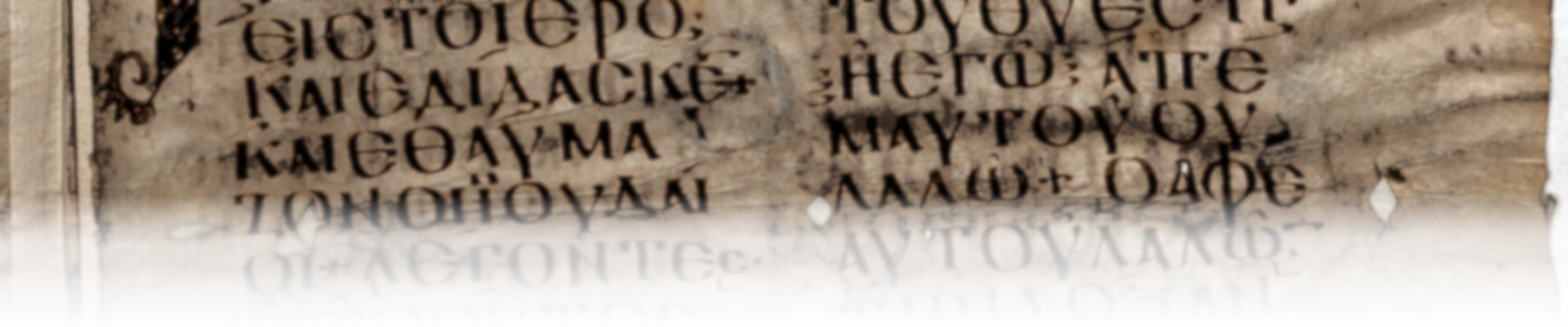
Usemos el texto griego para leer Jn 10:22–42.
Clave de lectura
E. Memorizando el texto griego
II. CONTENIDO
III. Práctica de exégesis:
Investigación previa (Logos AI, 2026-08-24)
Verificar antes de usar
Respuesta de Logos AI Study Assistant (2026-08-24), con citas autor/obra/página — contrastar contra el impreso antes de usar en clase (ver historial 2026-07-03/04 en Griego/CLAUDE.md sobre citas fabricadas).
Carson emphasizes the grammatical significance of the neuter form hen rather than the masculine heis, clarifying that Jesus and his Father are not one person—which would obliterate the distinction between Jesus and God already established in 1:1b—but rather are perfectly one in action and in what they do.[1] What Jesus does, the Father does, and vice versa.[1]
Carson acknowledges that this verse has generated profound and complex controversies, with Arians denying Jesus’ true divinity and many orthodox scholars holding that it supports only functional oneness.[1] However, he argues that an appeal to functional oneness cannot decisively prove the claim refers merely to a oneness of will or action devoid of metaphysical overtones, given that John’s Gospel openly declares the Word to be God (1:1, 18), contains the climactic confession “My Lord and my God!” (20:28), has Jesus take on God’s name (8:58), and portrays Jesus standing where God alone stands—so the reader should hesitate before denying any claim to deity in these words.[1]
Köstenberger similarly reads the statement as a deity claim. Jesus affirms his unity of purpose and mission with the Father in 10:30.[2] The statement echoes the basic confession of Judaism, “Hear, O Israel: The Lord our God, the Lord is one” (Deut 6:4).[2] For Jesus to be one with the Father yet distinct from him amounts to a claim to deity, and while the present emphasis is on the unity of their works, an ontological unity is presupposed—clearly more is in view than a mere oneness of will between Jesus and the Father.[2] The Jews, perceiving blasphemy, promptly pick up stones in a renewed attempt to kill Jesus.[2]
Both scholars read the neuter construction as intentionally preserving the Father-Son distinction while asserting essential unity in divine action and being—a formulation that provokes the stoning charge precisely because it claims deity while maintaining personal distinction.
Sources cited: D. A. Carson, The Gospel according to John, PNTC (1991), pp. 386–389; Andreas J. Köstenberger, A Theology of John’s Gospel and Letters (2009), pp. 226, 533. The search was constrained to these two authors. Would you like me to search your entire library instead?
[1] D. A. Carson, The Gospel according to John, The Pillar New Testament Commentary (Leicester, England; Grand Rapids, MI: Inter-Varsity Press; W.B. Eerdmans, 1991), 394. [2] Andreas J. Köstenberger, A Theology of John’s Gospel and Letters: The Word, the Christ, the Son of God, Biblical Theology of the New Testament (Grand Rapids, MI: Zondervan, 2009), 374.
Comentemos
IV. Cierre
Repaso del vocabulario
Ejercicio